Land-Based Wastewater Treatment System
This research was developed to help potato farmers find ways of dealing with large volumes of wastewater on their farms. What lead to this need was a combination of demands by industry for farmers to store, sort, and wash their potatoes prior to shipment and provincial legislature in place to protect Ontario natural water systems. Large volumes of potato wastewater were needed to be managed in a way that was both protecting the environment and also not be a financial burned on our potato farmers.
For more technical information about this research project, please refer to my master’s thesis (http://hdl.handle.net/10214/8754) or the resulting publications (Bosak et al. 2015, 2016a, 2016b, 2016c).
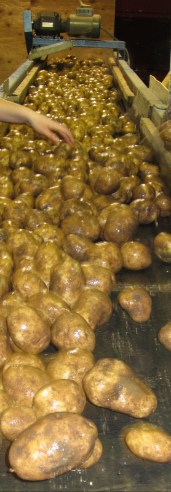
Harvested potatoes can be stored up to 10 months in storage facilities as the one seen above. They are sorted, washed, and shipped based on the demand of buyers. The wastewater is, therefore, created throughout the fall, winter, and spring.
Although the wash-water from the potatoes contains mostly soil and potato debris, the large amount of potatoes being processed create high concentrations of organic matter and nutrient contaminants. These need to be treated out of the wash-water before it can be allowed to flow out into the natural water system.
When potato shipping is done, the wastewater is pumped out into the land-based treatment system, starting with a sedimentation basin.
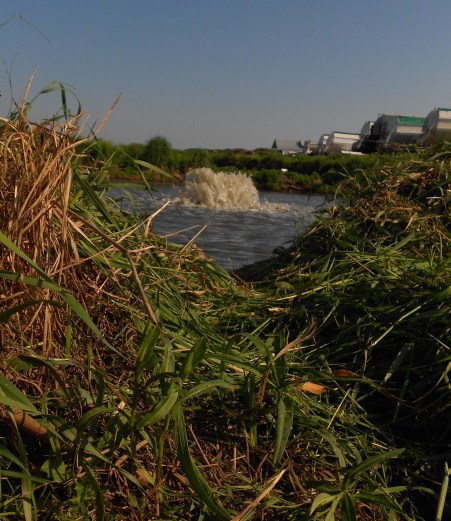
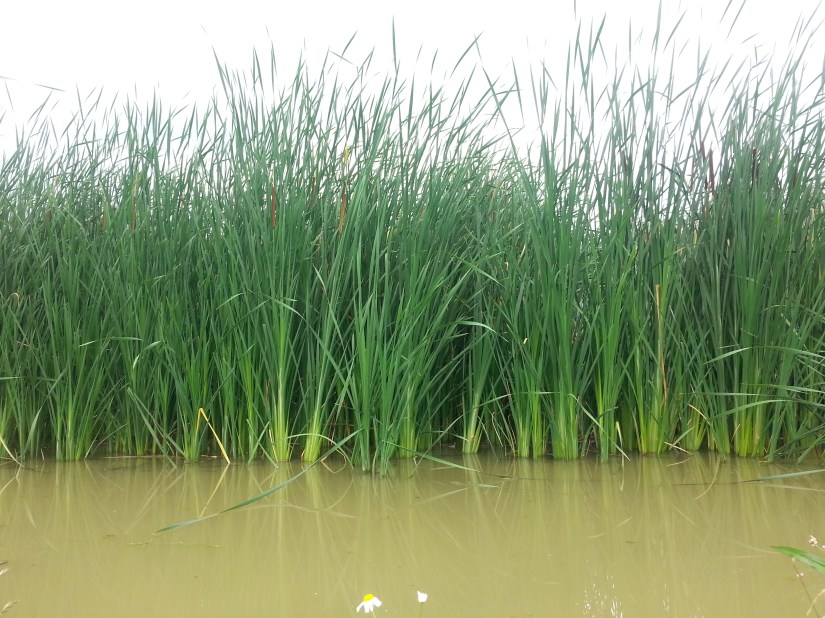
The treatment system was created adjacent to the storage facility and consisted of 5 basins, which were designed to predominantly settle out solids and increase oxygenation for nitrification to occur. We observed large amount of colloidal particles which floated in the water, rather than settling and also rapid oxygen consumption due to denitrification. Therefore the system included an aerator, a small wetland densely overgrown with cattails, and barrier filled with sand to slowly filter through water.
Bosak, V., VanderZaag, A., Crolla A., Kinsley, C., Chabot, D., Miller S., Gordon, R., (2016) “Performance of a Constructed Wetland and Pre-treatment System Receiving
Potato Farm Wash Water”, Water, 8 (5), 183.
Sand Filtration
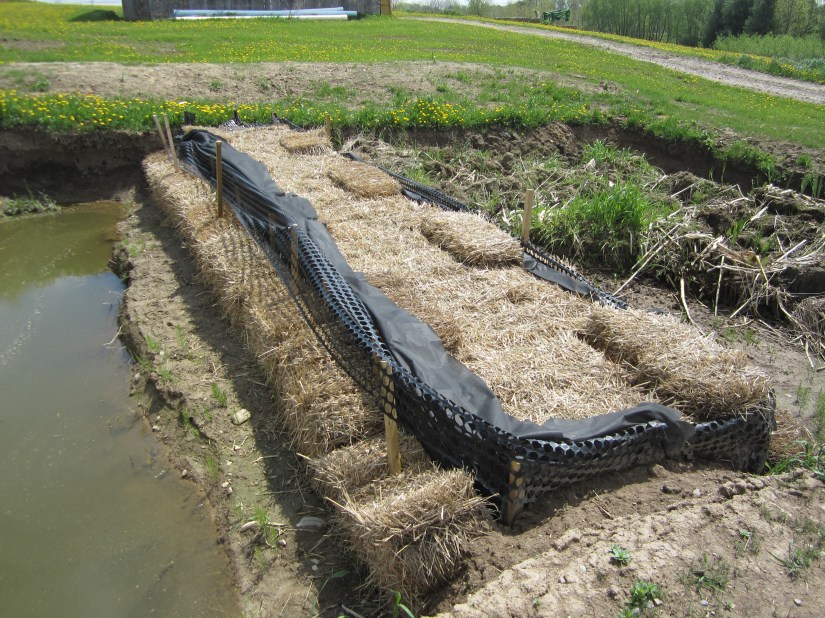
The large amount of colloidal particles in the potato wastewater lead to the development of the sand filter seen above. Prior to a full-scale implementation, however, we did some laboratory testing with the potato wastewater to properly quantify the expected treatment effects.

Horizontal and vertical flow filters were made of PVC piping and filled them with general construction sand. We created 4 blocks, each containing 3 vertical and 3 horizontal filters loaded at rates of: 150, 300, and 600 mL per day.
Due to the orientation of the filters, the horizontal filters remained saturated, while the vertical filters dried between loading times. The vertical filters had better removal of solids and markedly more nitrogen removal due to the repeated drying events.
Additionally, on average, as the loading rate decreased the solids removal efficiency increased.
Bosak, V., VanderZaag, A., Crolla, A., Kinsley, C., Chabot, D., Miller, S. S., Gordon, R., (2015) “Treatment of Potato Farm Wastewater with Sand Filtration”, Environmental Technology, 1-8.
Coagulation
Using chemical coagulants was another treatment for removal of solids which we tested in the lab. Coagulants are compounds which contact with suspended particles in water and cause them to coagulate by precipitation or enmeshment. This creates sweeping flocs which are then able to settle out of the water. We tested several coagulants on the potato wastewater from the farm, including: ferric chloride (FeCl3), aluminum sulfate (alum), and 2 Nalco brand polymer coagulants. Our goal was to do a comparison of the cost to farmers and the treatment efficiency of the coagulants.
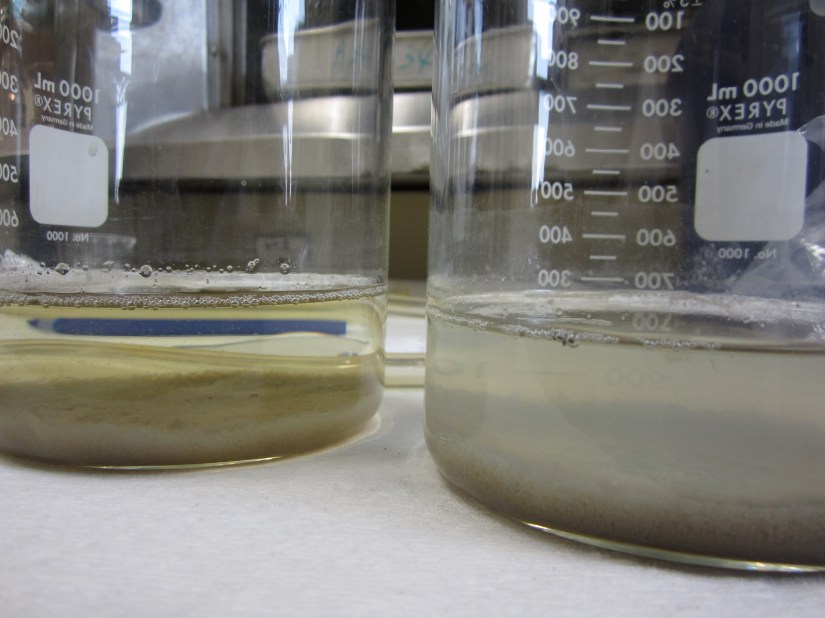
Alum and FeCl3 required more volume of coagulant and reduced the pH, which could disrupt treatment of nutrients in the wastewater. One of Nalco coagulants had a substantially better treatment efficiency, although also more costly. On-farm implementation is yet to be fully developed.
Bosak, V., VanderZaag, A., Crolla A., Kinsley, C., Chabot, D., Miller S., Gordon, R., (2016) “Treatment of potato farm wastewater with coagulation”, App Eng. in Agri., 33 (1), 95-101.
Acknowledgements
This research was possible due to the hard work of many people, including everyone at Sunrise Potato LTD., coop students, research assistants, and most importantly my supervisors and co-authors.
 Environmental Research - Vera Sokolov